
In-home ABA therapy for children with autism
Your child learns best where they feel safest. Our in-home ABA therapy brings expert, BCBA-supervised sessions directly to your family, building real-life skills in the real-life environment where they matter most.

The Autism Therapy Group is a family-owned ABA provider. Our therapists come to you in Illinois, Wisconsin, and Texas, ready to meet your child exactly where they are today.
What is in-home ABA therapy?
In-home ABA therapy is Applied Behavior Analysis delivered inside your child's own home. Instead of traveling to a center, our therapists come to you. A trained Registered Behavior Technician (RBT), supervised by a Board Certified Behavior Analyst (BCBA), works directly with your child in the spaces, routines, and relationships that make up their daily life.
This matters because skills learned at home transfer to real life faster. When your child practices asking for a snack using their own kitchen, calming down in their own bedroom, or playing alongside their own sibling, the skills are not abstract. They are immediate, meaningful, and far more likely to last.
Sessions are structured around your child's individualized treatment plan, typically running 2 to 4 hours per visit, scheduled around your family's routines. The number of sessions per week depends on your child's goals and their insurance-authorized hours.
Why in-home ABA therapy works
In-home therapy is not just a convenient option. For many children, it is the most clinically effective option. Here is why.
Skills that actually transfer to daily life
One of the biggest challenges in any therapy is generalization: getting a child to use a skill learned in one place in their real, everyday life. In-home therapy eliminates that gap almost entirely. Your child learns to brush their own teeth, request help from you, handle transitions in their actual morning routine, and manage emotions in their own space.
A familiar environment that reduces anxiety
For many children with autism, new places and unfamiliar routines are a real barrier to learning. At home, your child is already regulated, already comfortable, and already ready to engage. That means more productive therapy time from the very first minute.
Family involvement built into every session
In-home therapy does not just treat your child. It trains your whole family. Your child's therapist coaches you in the same techniques they use during sessions, so the learning does not stop when the therapist leaves.
No commute, no disruption to your schedule
Getting a child with autism to a center and back, on time, every day, is its own challenge. In-home therapy removes that entirely — our therapist arrives at your door, and your family stays in its rhythm.
Sibling and family dynamics as a therapeutic tool
Our therapists can incorporate siblings, parents, and other household members directly into sessions, turning everyday family interactions into structured learning opportunities that travel everywhere that family goes.
Therapy that can grow into the community
As your child makes progress at home, our therapists can extend sessions into your community — the grocery store, local park, library, or restaurant — building the kind of independence that is the foundation of our mission.
How an in-home ABA session works
Every session is different because every child's goals are different. Here is a picture of what a typical in-home visit looks like from arrival to wrap-up.
Arrival and transition
Your child's therapist arrives at the agreed time. For children who find transitions challenging, the arrival routine itself becomes part of the program — a real, teachable skill with real-world value.
1
 2
Structured skill-building
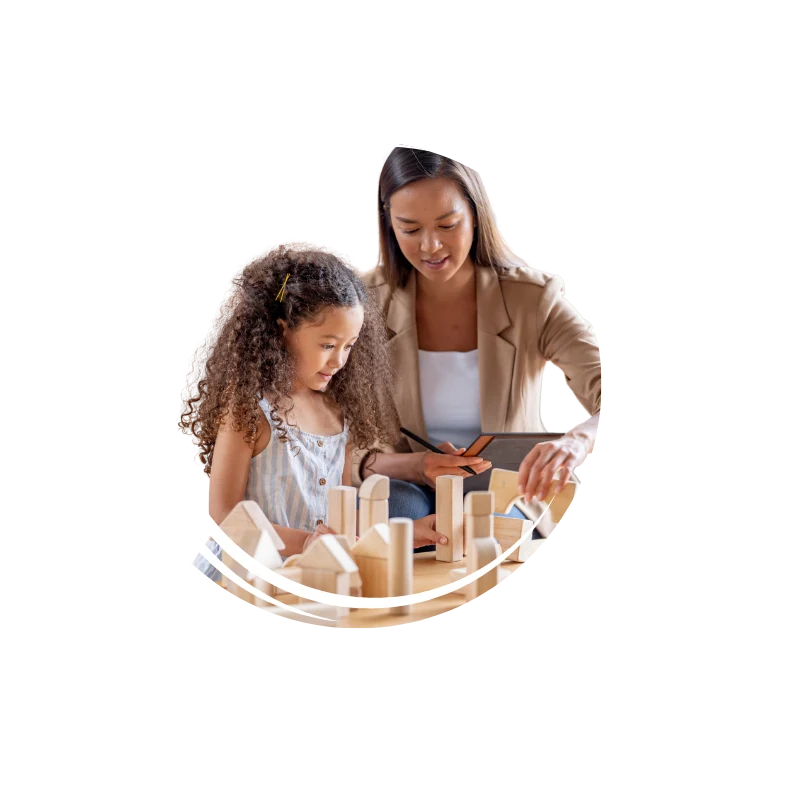
The core of each session focuses on your child's current goals: communication, self-care routines, social skills with family members, academic readiness, or reducing specific challenging behaviors, following your BCBA-designed treatment plan.
Natural environment teaching
In-home therapy uses your home's actual spaces as teaching environments — the kitchen for mealtime skills, the bathroom for hygiene routines, the living room for sibling play. The environment is already the real world.
3
 4
Parent coaching
Your therapist models a technique, lets you try it, and gives you feedback. Over weeks and months, you build a toolkit you can use every waking hour of your child's day — a core part of every ATG in-home program.
Data collection and session notes
Your therapist collects data throughout the session on every skill and behavior target. That data goes to your supervising BCBA, who reviews it regularly and uses it to adjust the program.
5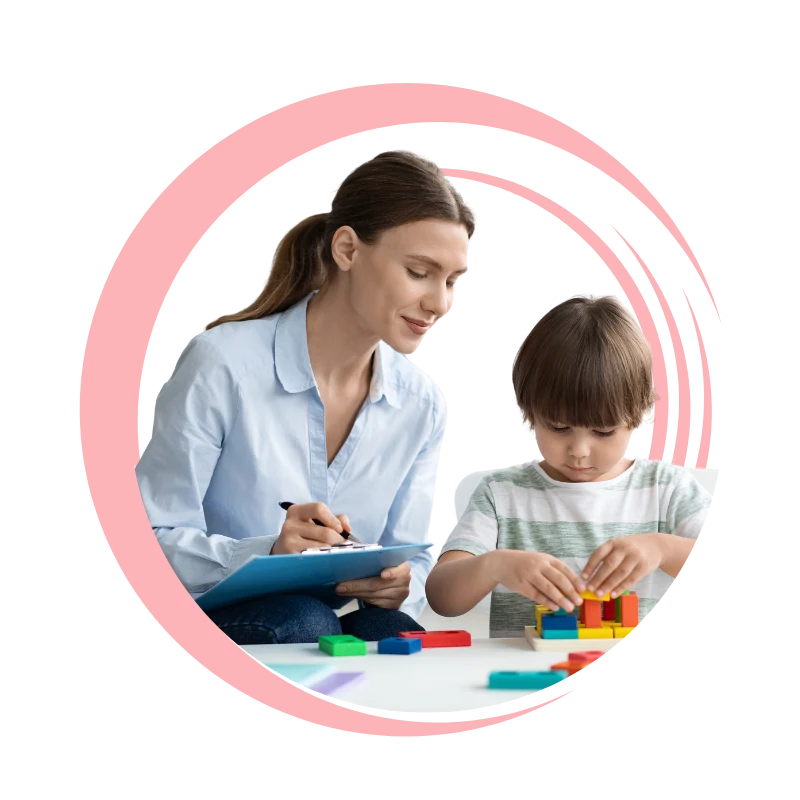
How to prepare your home for the first session
You do not need to change your home to make in-home ABA work. Our therapists are trained to adapt to any environment. That said, a few simple steps can help your child get the most out of early sessions.
Identify a consistent workspace
A corner of a room, a table, a small area with minimal clutter, works perfectly. Your therapist will help you choose the best spot based on what your child is working on.
Have your child's preferred items nearby
Motivating items, toys, snacks, or activities are used as positive reinforcement throughout sessions. Your therapist will ask you about these before the first visit.
Reduce background noise when possible
Turning off the television or reducing other household activity during session time helps your child focus. It does not have to be silent, just calmer than usual.
Let siblings know what is happening
If siblings are home during sessions, they may be included in parts of the session. A brief explanation, or just a heads-up, can prevent confusion and disruption.
Be present, but not hovering
Your presence is valuable and your therapist will involve you at key moments. In between, staying nearby but out of the immediate therapy area helps your child focus on their therapist.
Who benefits most from in-home ABA therapy
In-home therapy is a strong fit for many children and families. These situations make it an especially good match.
- Children who struggle with transitions or new environments. If the stress of going to a center consistently interferes with your child's ability to learn, their own home removes that barrier entirely.
- Children working on daily living and self-care skills. Toilet training, hygiene routines, mealtime behaviors, dressing, and household safety skills are all best taught where they will actually happen.
- Families who want deep involvement in the process. In-home therapy by design makes you a member of the therapy team, practicing techniques yourself and present for every session.
- Children who benefit from sibling or family interaction as part of their goals. Social skills practiced with real family members generalize faster and more durably than skills practiced with therapist stand-ins.
- Families facing center access barriers. Transportation challenges, inflexible work schedules, or distance from a center location are real obstacles that in-home therapy removes.
- Children receiving services as part of a hybrid plan. Many children attend our centers for high-intensity group time and receive in-home services to focus on daily living skills.
In-home vs. center-based ABA: what each setting offers
Both settings produce real outcomes. Which one — or combination — fits your child best is a clinical determination your BCBA makes through assessment, not a decision you have to make alone. See our full guide to in-home vs. center-based ABA therapy for a deeper look. Here is the quick version.
| Factor | In-Home ABA | Center-Based ABA |
|---|---|---|
| Setting | Child's home and community | Dedicated therapy center |
| Skill generalization | Strongest in home and daily routines | Strongest in school and community settings |
| Daily living skills | Strongest: practiced in the actual environment | Possible, with limited real-world context |
| Peer interaction | Limited to siblings and family members | Yes, daily with therapist support |
| School-readiness prep | Moderate | Strong: center mirrors classroom routines |
| Family involvement | High: parents coached in every session | Moderate: parent meetings and updates |
| Therapy intensity | Typically 2 to 4 hours per session | Higher hours possible (up to full day) |
| Transportation required | None: therapist comes to you | Yes: family drives to the center |
Skills your child will build at home
Treatment goals are set individually for every child. In-home ABA programs are especially well-suited to these skill areas.
Daily living and self-care
Toilet training, dressing, handwashing, teeth brushing, and mealtime routines, practiced in the exact environment where they need to happen.
Communication
Requesting needs, answering questions, starting and ending conversations, and using language naturally in the home environment.
Family and sibling interaction
Playing alongside siblings, sharing, taking turns, navigating disagreements, and building the social skills that family relationships require.
Behavior Reduction
Replacing challenging behaviors like tantrums, aggression, self-injury, or elopement with appropriate, functional alternatives, targeted where they most often occur.
Emotional Regulation
Managing frustration, tolerating schedule changes, coping with transitions, and building resilience in the familiar context of home.
Community Readiness
As goals expand, sessions extend into grocery stores, parks, restaurants, and libraries, building the independence to navigate life beyond home.
Our therapists
The person who comes to your home every week is the most important factor in your child's progress. We do not take that lightly.
Every ATG in-home program is supervised by a Board Certified Behavior Analyst (BCBA). Your BCBA designs your child's treatment plan, reviews session data regularly, adjusts goals based on progress, and meets with your family on a consistent schedule.
Day-to-day sessions are delivered by Registered Behavior Technicians (RBTs). Every behavior technician completes RBT certification: formal ABA training, a national competency exam, and ongoing BCBA supervision.
We have also been certified as a Great Place to Work multiple years running. Therapist retention is a clinical quality issue, not just an HR metric — a therapist who stays and builds a real relationship with your child is a better therapist.
What families say
“My son loves it here. He doesn’t want to leave when I pick him up. My family and I couldn’t be happier with them. I recommend this location.”

Insurance and payments
We accept most major insurance plans. Our intake team manages the benefits verification process from start to finish, so you do not have to navigate it alone. ABA therapy coverage has expanded significantly, and many families are surprised by how much their plan covers.

Where we provide in-home ABA therapy
In-Home ABA therapy is currently offered at the following ATG locations:
Illinois
- ItascaCenter-Based, In-Home and Hybrid
- LombardCenter-Based, In-Home and Hybrid
- NapervilleCenter-Based, In-Home and Hybrid
- RockfordCenter-Based, In-Home and Hybrid
- SpringfieldCenter-Based, In-Home and Hybrid
Texas
- Universal CityCenter-Based, In-Home and Hybrid
Wisconsin
- BrookfieldCenter-Based, In-Home and Hybrid
Looking for a different approach?
Early intervention at home
Young children often learn best in the places they already know. In-home sessions let your therapist teach early communication, play, and daily routine skills right where your child uses them, and the same team keeps supporting your child as they grow. Learn more about early intervention ABA.
Parent training is part of every ATG program, in every setting. See how it works in our Parent Guide.
Common questions
Can ABA therapy be done at home?
Yes. In-home ABA therapy is a well-established service model with strong clinical support. A Registered Behavior Technician (RBT), supervised by a Board Certified Behavior Analyst (BCBA), delivers structured therapy sessions in your child's home. The same evidence-based ABA principles that guide center-based therapy apply in the home setting, with the added advantage of real-environment generalization.
What does an in-home ABA therapist do?
An in-home ABA therapist (RBT) delivers the day-to-day therapy in your child's home under the supervision of a BCBA. During sessions, the therapist works on your child's individualized goals, collects data on progress, coaches parents in ABA techniques, and uses natural home environments and family routines as teaching opportunities.
What does an in-home ABA session look like?
A typical in-home session starts with the therapist arriving and helping your child transition into work mode. Most of the session focuses on structured skill-building, using your home's actual spaces and routines. The therapist also coaches you during the session and closes with a brief summary of what was worked on. Sessions typically run 2 to 4 hours.
How much does in-home ABA therapy cost?
For most families, the out-of-pocket cost of in-home ABA therapy is determined by their insurance plan. Most major insurance carriers cover ABA therapy when medically necessary, and ABA therapy is considered medically necessary for children with an autism spectrum disorder (ASD) diagnosis. Our intake team verifies your benefits at the start of the process and explains your coverage clearly before any services begin. Contact us to get started.
Can a parent do ABA therapy at home?
Parents can and should reinforce ABA strategies between professional sessions, but in-home ABA therapy is delivered by trained, certified professionals. What parent coaching in our programs does is teach you the principles and techniques your child's therapist uses, so you can apply them consistently throughout the day. Learn more about parent training in our Parent Guide.
What is the difference between in-home and center-based ABA therapy?
In-home ABA therapy happens in your child's home, built around their natural environment and daily routines — especially strong for daily living skills, self-care, family interaction, and anxiety-sensitive children. Center-based ABA takes place in a dedicated center, providing a more structured environment, peer interaction, and classroom-like routines. Many children benefit from a combination of both. See our full comparison guide or contact our team for a recommendation specific to your child.
How many hours of in-home ABA therapy does my child need?
The right number of hours depends on your child's needs, their treatment goals, and what their insurance authorizes. Research supports intensive ABA (20 to 40 hours per week) for many children, especially during early intervention. The specific recommendation comes from your child's BCBA after a thorough assessment.
Does my child need an autism diagnosis to receive in-home ABA?
In most cases, yes. Insurance coverage for ABA therapy typically requires an autism spectrum disorder (ASD) diagnosis. If your child does not yet have a diagnosis, we can help guide you toward the next step.
Do I need to be home during the sessions?
For most in-home programs, a parent or authorized caregiver should be present in the home during sessions. This is both a safety standard and a therapeutic opportunity — it allows your therapist to coach you in real time. You do not need to be in the same room throughout the session, but you should be available and reachable.
What should I do to prepare my home for ABA therapy?
Very little is required. Your therapist will adapt to your home as it is. A few things that help: identify a consistent space for sessions, have your child's preferred toys or snacks available for reinforcement, and reduce background noise if possible during session time.
What is the difference between a BCBA and an RBT?
A Board Certified Behavior Analyst (BCBA) is a licensed clinician who holds a master's degree in behavior analysis and oversees all clinical decisions. A Registered Behavior Technician (RBT) is a trained paraprofessional who delivers the day-to-day therapy under the BCBA's supervision. Every behavior technician completes RBT certification.
Ready to get started?
We verify insurance at no cost and can usually get you scheduled within the week.